The Second-Screen Hangover: Why Half-Watching Is Ruining Telly (And My Three-Night Fix)
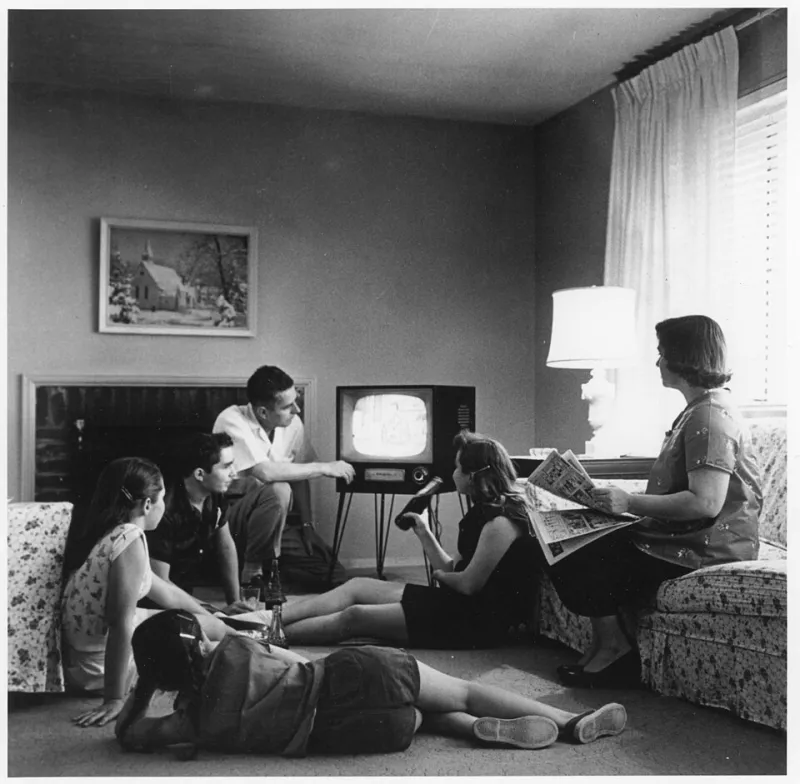
Photo: Evert F. Baumgardner, Public domain, via Wikimedia Commons
It's 9pm on a Tuesday. The telly is on. Your phone is in your hand. You've just spent ten minutes scrolling through a group chat about a programme you're supposedly watching, and you couldn't tell me what happened in the last scene. Welcome to the half-watch — Britain's default telly setting in 2026.
We're not talking about the odd glance at a notification. This is the full second-screen shuffle: phone in one hand, remote in the other, eyes flicking between a prestige drama and a supermarket app. We claim to love telly. We give it our evenings. But increasingly, we're giving it about sixty per cent of our attention and wondering why nothing lands anymore.
The Experiment: Three Nights, One Phone-Free Sofa
I decided to test it properly. Three nights, one rule: phone stays in the kitchen. No exceptions, no 'just checking the time'. The telly gets my full attention, or at least whatever attention I've got left after a day of staring at a work laptop.
Night one was fidgety. My hand kept drifting towards my pocket like a smoker reaching for a lighter. I noticed every ad break, every slow bit, every moment where the plot didn't immediately grab me. I also noticed that I'd been using my phone as a cushion against boredom — a way of softening the boring bits without actually admitting the show wasn't working.
Night two was calmer. I watched a Channel 4 documentary I'd been meaning to get to for weeks. I remembered the names of the people in it. I didn't rewind once.
Night three was the interesting one. I laughed at a joke without immediately checking whether anyone else found it funny. I sat through the credits. I actually thought about what I'd watched afterwards, rather than instantly flooding my brain with something else.
What I Found (Spoiler: It Was Weirdly Uncomfortable)
The first twenty minutes of each phone-free night were the worst. Not because the telly was bad, but because my brain was expecting a hit of something else. A notification, a headline, a little dopamine snack. Without it, I felt restless. That's not a great advert for my attention span.
But here's the thing: the experiment also exposed which telly actually deserved my attention. Some shows survived the phone ban easily. Others suddenly felt like hard work. That's useful information. If a programme can't hold you for forty-five minutes without a second screen, maybe it's not the programme you love — maybe it's just the habit of having something on.
Why We Do It (It's Not Just Rude)
Second-screening isn't malicious. It's a fidget. We do it during ad breaks, during slow openings, during the bit where a character we don't recognise starts explaining a plot point we've already guessed. We do it because our phones are designed to be more immediately rewarding than almost anything on telly.
There's also the social thing. Group chats run alongside the show. You're not just watching — you're watching with other people, in real time, even if they're in a different city. That's not nothing. But it does mean you're never fully in one place.
The Cost: Plot Holes, Rewinds and the Death of the Watercooler
The obvious cost is that you miss stuff. You rewind. You ask 'who's that?' about a character who was introduced twenty minutes ago. You lose the thread of a thriller because you were reading a text about bins.
The less obvious cost is that telly stops being an event. The shared watch — the thing you talk about the next day at work, the thing that makes a show feel bigger than the sum of its episodes — gets diluted when everyone watched a different version of it. You watched the show. Your mate watched the show plus their phone plus three notifications. You're not really talking about the same thing.
The Rules: How to Reclaim a Proper Watch
You don't need a digital detox. You need a few boundaries that don't feel like punishment.
1. Phone in another room for drama and film. Not face-down on the sofa. Not in your pocket. Another room. The friction matters. If you have to get up to check it, you'll check it less.
2. Ad breaks are for phone time. If you're watching commercial telly, use the breaks. Scroll, reply, check the football scores. Then put it down when the programme comes back. This one rule alone makes a massive difference.
3. The twenty-minute test. If you reach for your phone twice in the first twenty minutes, the show isn't working. That's not a moral failing. Turn it off and watch something else. Life's too short for polite half-watching.
4. Be honest about background telly. Some telly is wallpaper. That's fine. Bake Off repeats, quiz shows, the news you're not really listening to. Just don't pretend you're watching a gripping drama when you're actually online shopping.
5. One screen for finales. The last episode of something you've invested in deserves your full attention. Phone away. Lights down. Actually watch it. You'll remember it better, and you'll probably enjoy it more.
The Verdict
Second-screening isn't evil. It's a tool, and sometimes it's a lifeline during a dull first act. But default half-watching is a tax on the stuff you claim to love. You're not really relaxing, and you're not really watching. You're just splitting the difference and getting less of both.
My three-night experiment didn't turn me into a monk. I still check my phone during ad breaks. I still scroll during quiz shows. But for the stuff I actually care about, the phone goes in the kitchen. The telly gets my eyes. It turns out that's still the best way to watch it.
Reviewr rating: proper watching 4/5. Half-watching with phone in hand 2/5. The difference is bigger than you think.